
Genocide .live

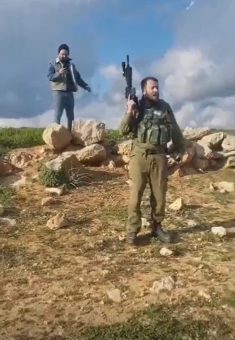
In the farsh lands near Susya: settlers Nachman Goldring and the notorious Shem Tov Lusky
Original Social Media Post
"Today in the Farsh lands near Susya: settlers Nachman Goldring and the notorious Shem Tov Lusky arrived in an attempt to prevent Palestinians from harvesting their wheat crops in area west of the village of Susya. They trampled the crops and tried to drive the harvesters away" - Source
Archivist Notes On This Video
"Farsh lands", Al-Farsh, refers to agricultural and grazing land associated with Palestinian families around the village of Susya in the South Hebron Hills.
There is no single officially defined place called "Farsh Lands", but in the Susya context it generally refers to the relatively flat agricultural valleys and pasturelands surrounding the village, especially to the south and southeast of the original village site. Families from Susya have traditionally used these lands for olive groves, farming, and herding.
Event Notes
Settler attacks on Wadi a-RakhimOn April 25, 2025, Palestinian farmers were forced to harvest wheat weeks early due to repeated harassment by Israeli settlers and risk of crop destruction. Members of the Al-Huraini family, supported by activists, attempted to harvest their fields but were repeatedly confronted by settlers who grazed livestock on the land, damaged crops, and intimidated harvesters. Earlier attempts had already failed after settlers reportedly chased farmers away and damaged fields, including an incident where a nearby villager was shot and seriously injured. During the final attempt, settlers again interfered, but Israeli soldiers eventually arrived and ordered the settlers to back off, allowing the harvest to continue under tense conditions. Despite ongoing threats, the farmers managed to collect part of their crop, describing it as a partial success under difficult circumstances, though they remained under pressure to harvest additional fields.
On March 7, 2026, A settler in military uniform shot and killed a farmer after settlers invaded his family’s land and attacked his father. the local farmer Khaled Shinaran was shot by the settler Luria Luski whil his brother Tov was behind him. He died later in the same day. His brother and 4 other people were injured by settlers or further soldier raid on the family home. See event
On May 1st, 2026, at 13:10, a group of settlers from the "Susya" colony in the Wadi A-Rakhim area in Masafer, the town of Yatta, burned a bulldozer (Bajer) and a vehicle owned by the citizen Ahmed Nasr Al-Daajneh.
On May 18, 2026, around 4:00 a.m., Israeli settlers set fire to a sheep pen and a traditional clay oven after infiltrating a home in the Wadi Al-Rakhim area, near the town of Yatta in the southern occupied West Bank. According to witnesses, the homeowner sustained burns to his hand while attempting to extinguish the fire.
On July 16, 2026, around 08:10, a group of settlers entered the Wadi Al-Rakhim area in the Masafer town of Yatta, attacked the homes of the Shenaran family, and beat a number of them, resulting in 3 of them sustaining injuries and fractures, and they were taken to the hospital for treatment. The 3 wounded are: Hudhayfah Muhammad Shanaran, Muhammad Musa Shanaran, and Mahmoud Omar Shanaran.
On July 18, 2026, Israeli settlers attacked Palestinian homes in Wadi Al-Rakhim, south of Yatta, Hebron, under the protection of Israeli forces, stealing three sheep. They also poisoned several of them. Israeli soldiers fired live ammunition, and a child was hospitalized after suffering severe shock. In a separate incident in As-Samu’, residents confronted settlers attempting to steal livestock and forced them to leave.
On October 5, 2026, in the afternoon the settlers began constructing a building adjacent to a Palestinian family's home in Wadi Rakhim, Area B with the clear intent to block access and impose a blockade on the home. Months ago, the same settler group erected an outpost right across the other side of the valley only hundreds of meters away, using it as a launchpad for violent attacks against local residents, including arson of homes and property. In response to the frequent attacks, the military recently issued a general's order barring Israelis from entering the area where the outpost was established. Nevertheless, the order is not being enforced, and the settlers remain on site. Despite repeated demolitions by the military, the outpost is routinely rebuilt within hours. The security forces' apparent inaction regarding this group reflects a policy choice that enables ongoing violence. Although the military and police received real-time reports regarding the new construction, no forces arrived at the scene. (Report from kivsa shchora)