
Genocide .live

Traces of blood of Palestinian Shaker al-Ja'bari, killed and abducted by Israeli forces in Khallet al-Hadour
Original Social Media Post
"And of course in the خليل (Hebron) Traces of blood of Palestinian Shaker al-Ja'bari, who was shot by Squatter forces in Khallat al-Hadura in Hebron." - Source
Event Notes
Assassination of Shaker Falah Ahmed al-Ja’bari in HebronOn January 10, 2026, late Saturday night, in Hebron/Al Khali in the Khallet Hadour area, in the occupied West Bank, Israeli forces shot and killed a Palestinian man, Shaker Falah Ahmed al-Ja‘bari, 58.
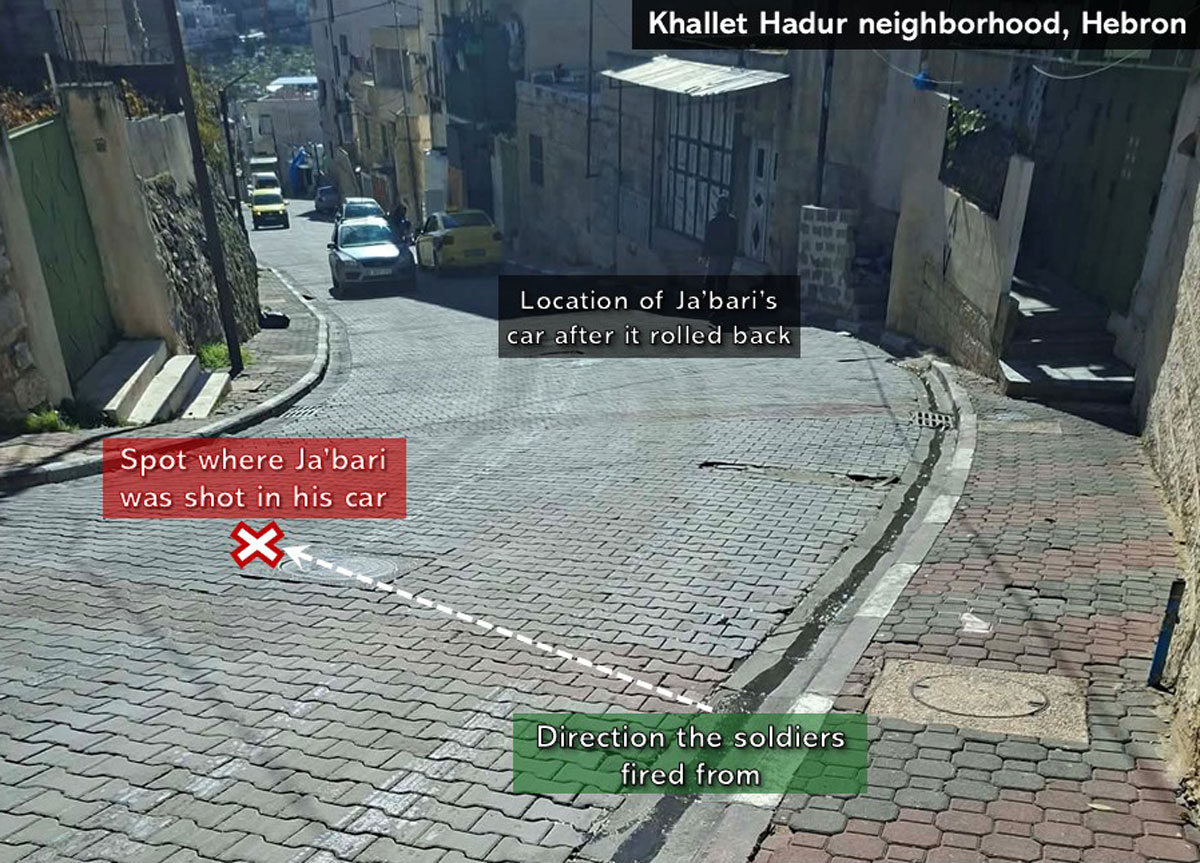
Israeli soldiers opened fire on al-Ja‘bari’s vehicle as he was returning after picking up his daughter and her children. He was shot directly while driving, despite being accompanied by family members. His daughter and grandchildren were later released.
Al-Ja‘bari was detained while critically wounded, and Israeli forces prevented Palestinian ambulances and civilians from reaching him, denying him timely medical care. Several hours later, he succumbed to his injuries.
The Palestinian Ministry of Health confirmed his death on Sunday morning after being notified by the General Authority of Civil Affairs.
Israeli authorities subsequently withheld his body, preventing medical teams and his family from receiving it. The Israeli army later claimed the incident was an alleged “attempted car-ramming attack”, without presenting evidence.
Palestinian media reported that al-Jaabari’s children were inside the vehicle with him. They stated this fact contradicts the claim that he was attempting to ram soldiers. Quds News Network reported the killing and the detention of his body.
Subsequent Israeli military statements / backtracking
The IDF later said that “no evidence was found” indicating a terror attack. The military clarified that soldiers fired because the vehicle “accelerated toward them” and they felt an immediate threat. An official IDF statement said: “At this stage, no conclusive findings indicate that the incident constituted an intentional terror attack.”
However, as of Sunday, January 11, 2026, the body remained withheld.
On January 12, Israeli soldiers returned the body of Shaker al‑Ja’bari to his family, while they invaded several neighborhoods in the city of Hebron, abducting two other Palestinians.
His body was transferred to Al‑Ahli Hospital in Hebron, and his funeral is scheduled to take place the same day following the noon prayer.
Name of the martyr:
Shaker Falah Ahmed Al-Jaabari, 58 y/o
Investigation of B'tselem
"On February 8, B'tselem Human Rights Oranization published a report after their investigation:
"Saturday, 10 January 2026, at around 8:45 P.M., Shaker Ja’bari, 58, was driving his daughter, Raslan Ja’bari, and her four young children in his car in the Khallet Hadur neighborhood in Hebron, when he suddenly noticed a group of soldiers walking up the street ahead of him. Ja’bari screeched to a halt, and then one of the soldiers fired three shots at the car. One of the bullets went through the windshield and hit Shaker Ja’bari in the forehead. Two of his grandchildren, Juri, 11, and Muhammad, 9, got out of the car and ran away, shouting and crying. A local resident who witnessed the incident helped Raslan Ja’bari get out of the car with her two younger children, Julia, 2, and Rayan, 5, and took them into the home of his relatives who live nearby, without their older siblings. From there, the family tried to call an ambulance for Shaker Ja’bari and his daughter, who was in shock and fainted several times, but the Palestine Red Crescent Society said that an ambulance was already in the area and the military was preventing it from reaching the scene. A paramedic who spoke with B’Tselem confirmed that two ambulances approached the scene of the shooting from two different directions, but the military prevented them from reaching the wounded Ja’bari. Later, neighborhood residents brought Juri and Muhammad to the house where their mother and two younger siblings were, and then another ambulance arrived and took Raslan Ja’bari and her children to ‘Aliya Governmental Hospital in the city. Shortly after the shooting, a military jeep arrived and the soldiers removed Shaker Ja’bari’s body from the car and transferred it to a military vehicle. In the following hours, more forces arrived, and the area was put under closure. The soldiers searched the car, vandalized parts of it and threw personal belongings out. The soldiers also went door to door in neighborhood homes and businesses, checked footage from security cameras and seized a recording of the incident from a camera in one of the shops in the neighborhood. The military has not released the footage. The Israeli forces remained there until around 3:00 A.M. After they left, residents began gathering around Ja’bari’s car, which had been left at the scene. Then, a Border Police jeep sped toward them, hitting another car that was parked on the street, and the officers fired tear gas canisters at the frightened residents, who fled the area. On the day of the incident, the military spokesperson issued its usual statement, describing the victim as a terrorist without any evidence, and claiming that, “IDF forces operating in the area fired at a terrorist who attempted to run them over. The terrorist was neutralized.” However, in a break from its usual practice, the military returned Ja’bari’s body the next morning, and he was laid to rest that afternoon. The military also walked back its initial accusation in a second statement posted that same day: “...a preliminary inquiry indicates that an IDF force operating in the area responded with gunfire to a vehicle that sped toward it, due to concern of an immediate threat. At this stage, no clear findings have emerged indicating that this was a deliberate attack, and the incident is still under investigation.” This is another case of an entirely unjustified killing of a civilian who posed no danger whatsoever to the troops, and paid with his life simply because he happened to be in an area where soldiers are in effect allowed to shoot with almost no restrictions. This reckless policy, which permits lethal fire against civilians, continues to claim lives time and again. The Israeli military’s consistent refusal to investigate incidents in which Palestinians are killed indicates that no one will be held to account for Ja’bari’s death, either"
Read two testomonies of relatives and witnesses.